It is understandable that each country has its own style of play, from the hackneyed description of the Brazilians’ samba, to the Italians’ (dolt-headed) defense-minded catenaccio, it’s an interesting combination of anthropology, geography, and political evolution that created these approaches to The Game.
For many countries, their style of play is as much a symbol of their national identity as other staples of their culture; cuisine, language, art, etc..
Because soccer is the uniting end-all for hundreds of countries on our Big Blue-Green Ball, it might be worthwhile to examine a country’s playing style in terms of their historical circumstances.
The problem is that my analysis could lead to a diverging ramble on my own false impressions of national stereotypes, such as: [Nationality] are greasy — their style of play is greasy — therefore, [Nation’s] soccer is cheap and greasy. That was an easy low blow coming from a squirly jerk like myself, but I’m willing to say that Americans are the most hypocritical and destructive force on earth, and the only thing that might keep us from not completely destroying the world – other than Obama – is our weak impact on international soccer.
The American soccer system is broken; a dead topic indeed but nonetheless even more glaring when even our most successful MLS executives leave to munch on the greener pitches in Europe (see: Ivan Gazidis). When it’s not just the players but the people in the suits leaving, then how can we keep the bodies and the minds around long enough to create a system that lasts? We United Statesians can’t criticize these moves to money and prestige and better training; das Kapital, no? South America deals with a talent exodus too, but we all know why Argentina and Brazil are consistently incredible: these countries have the infrastructure and enjoy a widespread popularity of the Game. These two factors are crucial to understanding why America, with its hegemonic dominance, has never gained a foothold in something so otherwise universally enjoyed.
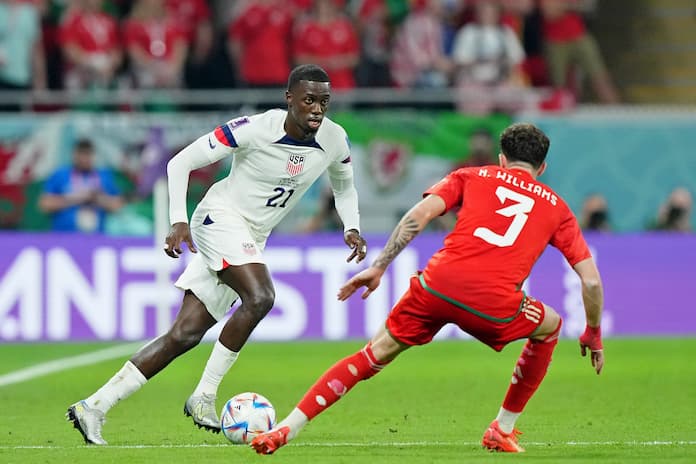
The Germans are solid, with limbic motions kept to a minimum. The Argentineans have been training since fetus-status to exert calories only in increments of 10. The U.S. men’s national team’s defining characteristic is their inefficiency and imbalance. Like Car Industry, Like Son; and the saying doesn’t go far enough. Our style is that we have no style. “We are” specifically because “we aren’t.” There has never been a defining feature of the American playing style, and I am willing to support the idea because we’ve been on the scene for a couple of decades now, the American soccer system has aged enough to have settled into this “non-style” of ours. Like a mid-life crisis, we realize that we have life, but something is still missing.
The homogeny of other national teams is nowhere to be seen in the U.S. squad. Whereas Spain’s national team consists of Spaniards (or Italy of Italians, Portugal of Portugese, and on and on), the U.S. national team consists of white-bread boys from California alongside the sons of immigrants from Kenya. Again, we have the case of a non-factor (in this case, a lack of homogeny) with which we can clearly define an opposing factor (heterogeneity). The result is that we can use these terms to better understand the characterization of the U.S. national team within a broader classification of geo-political soccer relations (does that even make sense? I hope so).
To make sense of these wily words, I’ll define what I mean by “geo-political soccer relations.” Mainly, soccer’s relationship with politics can be seen as a catalyst for peace as well as corruption. The symbolism of two countries setting aside their political differences to enjoy a gay ‘ole match was seen most recently in the meeting of Turkey and Armenia for a World Cup qualifier earlier this year. The game itself was secondary to the handshake between Turkey’s president Abdullah Gul and his Armenian counterpart Serzh Sarsgyan, an event that sparked headlines around the world and resulted in the end of 20 years of diplomatic silence between the two countries. In Germany, the World Cup in 2006 acted as The Great Sluice, and for the first time in who-knows-how-many years there were German flags in the streets, a scene previously owned by Hollywood War films.
Conversely, for every one good happening there seem to be dozens that reveal the a priori human vice: the “Calciopoli” in Italy, 2006; Pele and the UNICEF scandal; the pseudo slave-trade of players throughout the world; and so on and so forth. The Brobdingnagian amounts of money involved, as well as the so-large-they’re-comical egos, has created an ersatz world where billionaires compete to outbid their rivals while a community of shady businessmen bet, steal, intimidate, fight and vie for their own gangland glories of erections and pink nips.
It’s an interesting contrast, the black and white pentagons of the ball reflecting the greater good and evil that is as much the game as it is our shame. That’s why it wouldn’t be a good thing if the U.S. were to balloon into a soccer superpower. The money and publicity and pure kitsch filth would remove the water from the fishbowl, a dry-sticky guppy left behind. “But Will, didn’t you want the U.S. to get better,” you say. “Yes,” I’d reply, “I do still want our team to get better, but we can’t do to soccer what we did to Movies and Books and Iraq and the Native Americans (etc).” Not that soccer would be destroyed, and it can’t be much more Nike-ized than it already is; but it would be like having too many obese cooks in the kitchen.
The U.S. national team has the qualities of a worthy team, one that can make it to the quarter- or semi-finals of the next World Cup. Our non-style just needs to become a style, instead of merely assuming the role of one. The team itself is just too scrappy; needs more red meat; a super meal for constant losers named Constance and Luser who have never known a home field advantage. If it could be translated, the U.S. team’s story would make one awfully sappy hallmark card, with glossy sparkle-letters that could make a Topekan fat lady cry, but she’d still never watch a game.
Add Sportslens to your Google News Feed!