Jun
11
2008

Ian Blanchard, Head of National Referee Development at the FA, Discusses Law 11 and the Goal by Ruud Van Nistelrooy

Written by Steve Amoia

Ian Blanchard, Head of National Referee Development at the FA

Images courtesy of Ian Blanchard and the English Football Association.

In February 2008, I had the pleasure and privilege to interview Mr. Ian Blanchard, who became the Head of National Referee Development at the FA in 2005. He is responsible for the recruitment, retention, and development of all referees involved in the National game through to Supply League level. He also manages seven Regional Referees Managers.

At Euro 2008, three FA referees are taking part:
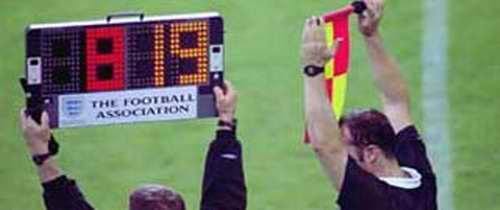
The FA Referees

  • Howard Webb
  • Darren Cann
  • Mike Mullarkey

Recent Controversy Over the First Dutch Goal Against Italy

On Monday night in Bern, the first Dutch goal by Ruud Van Nistelrooy created significant debate and subsequent discussion as we witnessed on Marco Pantanella’s excellent game report. I have contacted Mr. Blanchard, and he was kind enough to provide his expert analysis of the situation for all of us at Soccerlens.

After viewing the controversial goal by Van Nistelrooy on Monday night, along with the ensuing discussion, would you be kind enough to clarify the interpretation of the law?
In your experience, does this type of situation happen very often? Are most players or managers aware of the ruling when a defender (Panucci) either takes himself out of the play, or in this case, was pushed by his goalkeeper?

fa_on_bluethumbnail.gif“As far as I am concerned this incident is rare hence the debate and discussions.There are a number of factors to consider before making the correct decision, they include:1. Was the player in an offside position?
For the purposes of this incident the Goalkeeper is involved and is counted as one of the last two defenders.

2. Are there any other players nearer to the opponents goal line than the attacker and the ball?
Well the only other player to be counted is the Italian defender who was not actually on the field of play but had left due to his own momentum.

3. Is this player counted as being on the field of play at the time?
AS he left the field of play of his own accord, after a clash with a team mate, the ball was still in play. He should be included as one of the last two defenders as he is deemed to be part of play and counted as a defender.

4. What about players who leave the field deliberately to place a player in an offside position?
Technically speaking one could argue that the player has left the field deliberately and without the permission of the referee so therefore could be cautioned.

5. Should we consider that the ball remained in play and was part of one phase of play?
Yes it is important to understand that as the Italian player left the field of play the ball was played back and then crossed to the Dutch striker. This is all one phase of play. If the ball had been played out to the corner and several passes made this then would determine another phase of play being entered into.

So the end result is that on this occasion a great and correct decision was made by the Assistant Referee and supported by the referee.

I hope this helps with the discussions.

Best Wishes.”

I would like to thank Mr. Blanchard for taking the time to lend his expertise to this topic.

To visit the FA Refereeing site, please click here.

Steve Amoia is the author and editor of World Football Commentaries. He writes for Soccerlens and Keeper-Skool.


Discussion - 15 Responses

  1. Great job getting this interview. I am surprised and pleased by the pertinence and helpfulness of this article. Way to go SoccerLens.

  2. This article is fine up to a certain point,

    “AS he left the field of play of his own accord”

    Having watched a replay of the incident again, it is clear that he was knocked to the ground by Buffon. How he can be judged to have left of his own accord is beyond. Just another case of officials refusing to admit they made a mistake and then UEFA defending them no matter what.

  3. Geri:

    Mr. Blanchard is with The FA. Not UEFA.

    If you read his comment again, he noted the clash with Gigi Buffon. While I won’t claim to be able to read his mind, I believe that Mr. Blanchard meant by “on his own accord” that Panucci left the pitch without being officially stretched off.

    Igor:

    I am glad that you liked it. When you have some time, please read the first interview from February that was much longer. The link is found above.

  4. It seems to me that since it was Buffon who pushed him out it is different than if a Dutch player had, which I think is taken into account in the “of his own accord” part. I think the word ‘deliberately’ includes the deliberate actions of his teammate. Maybe I’m not interpreting it right, I don’t know….

  5. I didn’t say Blanchard was with UEFA. I said UEFA defended the match officials decision.

  6. The rule was put in place to stop defenders walking off the pitch and thus potentially puting the attacking side in an offside position. This clearly wasn’t the case here.

    There is a tendancy for UEFA, FIFA and refereeing organisations to close ranks when a poor decision has been made.

    Holland fully deserved to win that game. They opened Italy up at will, whilst Italy were shotgun-shy in front of goal. However, RVN’s goal should not have stood.

  7. Agreed with Geri on the tendency of referees to close ranks.

    However, I think that given the speed with which the incident took place, the decision given was correct. You could not tell, without checking with the physio’s report, whether Panucci had been injured or was taking an extra second to get up.

    Even more, Mr Blanchard’s comment makes the above discussion irrelevant:

    it is important to understand that as the Italian player left the field of play the ball was played back and then crossed to the Dutch striker. This is all one phase of play. If the ball had been played out to the corner and several passes made this then would determine another phase of play being entered into.

    That is, Panucci going behind the goal is considered to be part of the same move that caused the goal. Realistically speaking Panucci would have little chance of getting back up and getting into an onside position in time (we can debate this all day, so I suggest you time the # of seconds between Panucci’s tumble and RVN’s tap-in and then start your counter-argument).

    They close ranks, but they might have gotten it right this time.

  8. 2. Are there any other players nearer to the opponents goal line than the attacker and the ball?
    Well the only other player to be counted is the Italian defender who was not actually on the field of play but had left due to his own momentum.

    Wrong. I still can’t believe UEFA or anyone associated with refereeing is still refusing to call an orange an orange. Panucci didn’t leave due to his own momentum, he was knocked over by his own keeper.

    Distorting the facts from the video is exactly why people have so many problems with RVN’s goal, and aren’t buying UEFA general secretary David Taylor’s explanation.

    3. Is this player counted as being on the field of play at the time?
    As he left the field of play of his own accord, after a clash with a team mate, the ball was still in play. He should be included as one of the last two defenders as he is deemed to be part of play and counted as a defender.

    Part underlined is wrong again, see previous point.

    4. What about players who leave the field deliberately to place a player in an offside position?
    Technically speaking one could argue that the player has left the field deliberately and without the permission of the referee so therefore could be cautioned.

    Finally something we can all agree on. Deliberately leaving the field in order to place an opponent offside shouldn’t be allowed.

    5. Should we consider that the ball remained in play and was part of one phase of play?
    Yes it is important to understand that as the Italian player left the field of play the ball was played back and then crossed to the Dutch striker. This is all one phase of play. If the ball had been played out to the corner and several passes made this then would determine another phase of play being entered into.

    Finally starting to make sense.

    The following is how I see it ultimately. As the events played out, the linesman had a split second to consider the following: had Panucci left the field deliberately (or due to his own momentum)? He decided he did, applied the rule to the letter, and didn’t the raise the flag for offside.

    The only problem in all this? Panucci did not leave the field deliberately, was knocked over by his own keeper, and had no means, opportunity, or enough time to actively re-enter play, lying injured a good 6 yards away from the goal line. There is no way anyone on the playing field still considered him to be part of play, Ruud Van Nistelrooy included.

    Bottom line: can the decision to allow the goal be justified according to the rules? Yes.
    In hindsight and taking a close look at the events (Panucci clearly unintentionally exiting the field), was it the right decision? No.

  9. 12/06/2008 guillermo

    it doesn’t matter if a player leaves the field deliberately or not. until the play stops and the referees gives hïm “permission” to be out of the play, he is still in the play.

  10. the speed of the incident does not allow the ref the luxury to assume that Panucci is ‘out of play injured’ – as far as he knows (from what I saw) Panucci was knocked over by his own teammate and then didn’t get up in time during a potential goal-scoring play (possibility of him trying to slow things down).

    Without *knowing* whether the player is injured or not, the linesman cannot reasonably decide in his favor.

    There is no luxury of hindsight, and while we can argue all day whether he was still part of active play or not, I think the call made would have been made 90% of the time.

    I can say that I wouldn’t have made the call, but it’s clear to see why the linesman did. Yes, they’re going to close ranks (just as you’re adamantly defending Italy’s right to have justice) – but at this point arguing any further won’t accomplish anything.

    And above all, it’s poor form to criticise guests :)

  11. Ahmed, whether the linesman made his decision in good faith or not is irrelevant. It was still, all things carefully analyzed, the wrong decision. That’s been my point all along. I’m not blaming the linesman (too) much for making it, I already conceded that he had very limited time. However, just as one could say (in a completely different situation) “Player #9 was 1 foot offside as we can very clearly see on the video, but it was a really close call to make given the speed of the play, I don’t blame the linesman“, it still doesn’t make the ref’s decision the right one.

    I know full well that arguing about it won’t change anything. Hell, even if RVN had been allowed to stand 10 yards offside and score a goal in another play, the entire country would be calling for murder but we still wouldn’t be able to turn back time to change it.

  12. 13/06/2008 There's only 1 keano

    It just goes to shows that many of these so called football fans are just bloody groupies. This is due to the lack of comment on this particular post, but if one were to post something about footballers and prostitutes you’d be amazed at the number of replies streaming in!

  13. I suppose one thing not being asked is, what would have happenned if Panucci had managed to regain his feet and get back to prevent RVN from scoring?

    Do people think this would have been allowed? If so then you are clearly of the opinion that Panucci is still active and able to re-enter the field of platy without requiring the refs permission and as such the goal was correctly allowed.

    Whether he left by his own momentum or via a collision with his own team mate is irrelevant, the key point is he didn’t end up where he did via contact with a Dutch player.

  14. The player has to be considered onfield, no matter in which part of the field he is, if ref permission has not been taken to leave the field.

  15. This just prives my point about UEFA closing ranks:

    “According to reports, UEFA will defend the decision to disallow Luca Toni’s goal against Romania”
    Reports from unnamed sources within UEFA suggested the official line would be that it was disallowed for Alessandro Del Piero’s offside position.

    This was a tenuous explanation, as not only was Del Piero arguably not in an active position, he was also level with Codrea.

    This was their line until:

    “Referee Tom Henning Ovrebo has admitted he “made a mistake” in disallowing Luca Toni’s goal against Romania”
    “There is nothing to discuss. I made a mistake on Toni’s goal and I said the same to the UEFA Commission,” confessed the Norwegian

Developed by Football Media | All Content is under Copyright Protection | © 2006-2009 Soccerlens - Football News