


To be a legendary GOALKEEPER, you have to be more than a great shot-stopper, physical specimen, or reader of the game. You have to be an inspiration. You have to be that reassuring figure to your defenders, who know that they can afford to take chances or make mistakes since they have you between the pipes. You have to rise to the occasion, telling your teammates, your fans, your countrymen, that you will not be scored upon. Most importantly, you have to influence future generations of keepers, all of whom will aspire to be like you or maybe even better than you.
All of these keepers have been hugely successful, extremely influential, and massively inspirational. They’ve won titles and they’ve won prizes, but they’ve also won the hearts and minds of their peers, their fans, and their successors.
We’ll go in chronological order.
.
.
.
Ricardo Zamora |
 |
|
| SPAIN | ||
| 1916-1938 | ||
| Espanyol (1916-1919, 1922-1930) Barcelona (1919-1922) Real Madrid (1930-1936) OGC Nice (1936-1938) |
||
.
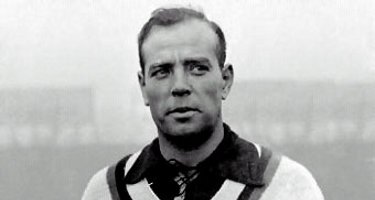
With his matinee idol good looks (Marca once referred to him being “as famous as Garbo, and better looking”) and Beckham-esque sense of style (he wore a cloth cap and a white polo-neck jumper, which he claimed protected him from the sun and from opposing players, to say nothing of the Fashion Police), “El Divino” is considered to be the first football superstar in Spanish history. He won five Copa Del Rey championships, five Catalan Club Championships (which existed before La Liga), and two La Liga titles. He wasn’t all style over substance, though. He was known for his toughness and bravery, frequently playing despite severe injuries. He is, perhaps, most famous for playing with a broken sternum against England, a match in which Spain became the first team from outside the British Isles to defeat England.
He was a member of the very first Spanish international squad and won a silver medal at the 1920 Olympics. He was also the starting goalkeeper for the Spanish side that went all the way to the Quarterfinals in the 1934 World Cup. He was Spain’s most capped player for 38 years before being surpassed by José Ãngel Iribar.
He was every bit as controversial as he was accomplished. Like Lev Yashin (see below), he enjoyed drinking and smoking, and was known to smoke up to three packs of cigarettes a day (good thing he didn’t play in the midfield). He was sent off in the 1920 Olympics for punching an Italian player, and was arrested on his way home from the Olympic games for trying to smuggle Cuban cigars into Spain. He tried to conceal part of his signing-on fee with Espanyol so that he wouldn’t have to pay taxes on it, and was suspended for a year.
Politically, he was one of the rare Spanish players of that era who found favor with both Nationalists and Republicans. He played for the Catalan National Team, but controversially transferred to Real Madrid, which was the preferred side of Francisco Franco, the Generalissimo who tried to suppress Catalan Nationalism upon becoming dictator of Spain. He was given a medal by the Republican government, which obviously didn’t take because he was later captured by the Republican Army during the Spanish Civil War, and was rumored to have been killed. He managed to escape to France, where he played his last two years with OGC Nice before returning to Spain, where he received a medal from Franco.
Despite his shifting political allegiances, he is still revered in Spanish football. The award for outstanding goalkeeper in La Liga is named the Ricardo Zamora Trophy.
Ricardo Zamora VIDEO:
.
.
.
FrantiÅ¡ek PlániÄka |
 |
|
| CZECHOSLOVAKIA | ||
| 1923-1939 | ||
| Slavia Prague . . . |
||
.
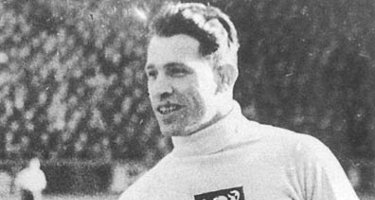
One of the greatest players in Czech history, PlániÄka possessed lightning-quick reflexes and was a great shot stopper, despite the fact that he was fairly undersized for a goalkeeper (he was 5’8”). He appeared in 969 matches for Slavia Prague, and helped establish that side as one of the best in Central Europe. He won eight Czech league titles and five Bohemian Cups (Czechoslovakia’s top domestic cup).
He established his reputation as one of the greatest and bravest goalkeepers in the world with by captaining Czechoslovakia to the 1934 and 1938 World Cups. The Czechs advanced to the Finals to face host county Italy in 1934, and forced the match into extra time despite playing in front of a rabid and fervent Italian crowd, including one Benito Mussolini. Four years later, PlániÄka and the Czechs faced Brazil in a violent match that was dubbed “The Battle of Bordeaux.” As a result of lax officiating, the match denigrated into a tackle-football game as both sides committed atrocious fouls that resulted in three players getting sent off, numerous other players leaving the pitch with injuries, and PlániÄka suffering a broken arm. Despite the injury, PlániÄka continued to play and did not concede any goals for the rest of the match, which went to extra time. PlániÄka didn’t play in the replay, however, and his team was eliminated from the World Cup.
Despite having plenty of provocation, PlániÄka refused to engage in the kind of UFC-style antics employed by his fellow footballers on that day, which was in keeping with his history of sportsmanship and fair play. He was never booked or sent off, and received the UNESCO Fair Play Award in 1985. Jens Lehmann sure can’t say the same thing.
Perhaps his enduring legacy is that he proved that it isn’t the size of the dog in the fight that counts but the size of the fight in the dog. PlániÄka had plenty of fight for anyone.
.
.
.
Amadeo Carrizo |
 |
|
| ARGENTINA | ||
| 1945-1970 | ||
| River Plate (1945-1968) Millonarios (1969-1970) . |
||
.
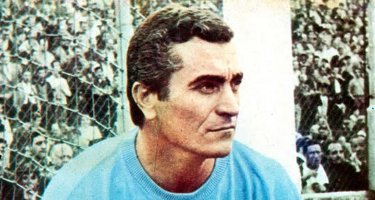
Carrizo was known as “Tarzan,” presumably due to the ease with which he swung between the posts, but wasn’t just a fantastic athlete. He was also an innovator who introduced a number of concepts to the modern science of goalkeeping. He was the first to wear gloves. He was the first to use goal-kicks as a means of springing counterattacks. He was the first to leave the penalty area to defend the goal. His tactics helped him set a record for appearances for River Plate, while winning five league titles. He was especially dominant from 1955-1957, during which time River Plate won three straight titles and Carrizo missed only one match. At the end of his career, he went to Columbia, where he won the Mustang Cup with Millonarios.
Unfortunately, his domestic success didn’t translate to the international stage. Argentina was in a state of decline during Carrizo’s best years, and Carrizo had a World Cup to forget in 1958. Carrizo conceded 10 goals as Argentina failed to get out of the first round. He fared better in the Nations Cup in 1964, winning the title in Brazil.
Most importantly, his style of play influenced an entire generation of goalkeepers, especially those from South America. Hugo Orlando Gatti, René Higuita, and José Luis Chilavert all owe a significant debt of gratitude to “Tarzan.” In all, he was a true pioneer that was every bit as successful as he was influential.
Amadeo Carrizo VIDEO:
.
.
.
Lev Yashin |
 |
|
| RUSSIA | ||
| 1949-1971 | ||
| Dynamo Moscow . . . |
||
.
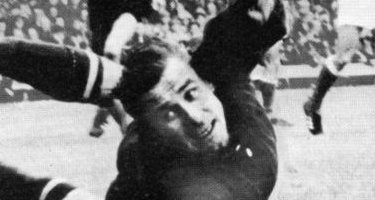
He spent his entire career behind the Iron Curtain, but anyone who knew anything about football knew about Lev Yashin. Nicknamed “The Black Spider” because of his intimidating all-black kit and because he, seemingly, had eight arms due to all the breathtaking saves he made on a routine basis, Yashin was universally regarded as the best goalkeeper in the world by his peers. Yashin led the Soviet Union to three straight World Cups, carrying his team to the Quarterfinals in 1958 and 1962. He also led the Soviet Union to the Olympic gold medal in 1956 and the European Championship in 1960. He won the Ballon d’Or in 1963, becoming the only goalkeeper ever to win that prestigious honor. His dominance was such that he finished first or second in almost every single meaningful poll to determine the greatest goalkeeper of all time.
He was respected for his leadership abilities on the pitch and often acted as a de facto skipper, even though he never actually donned the armband. Yashin also changed the way goalkeepers played the game. Until Yashin, it was unheard of for a keeper to punch the ball away instead of try to catch it. Yashin was also one of the first to utilize the quick throw in order to ignite counterattacks, and frequently ventured out of the penalty area. We may take these things for granted nowadays, but these tactics were novel concepts when Yashin brought them to the game.
He was one of the greatest shot stoppers of all time, reputedly stopping over 150 penalty shots. His training regimen was unique, as well. He admitted to smoking before a match as a way of calming his nerves, and then drinking to loosen up his muscles. Clearly, a number of athletes from all sports can give him credit for that innovation.
Lev Yashin VIDEO:
.
.
.
Gordon Banks |
 |
|
| ENGLAND | ||
| 1955-1978 | ||
| Chesterfield City (1955-1959) Leicester City (1959-1966) Stoke City (1966-1972) Cleveland Stokers (1967) St Patrick’s Athletics (1977) Ft Lauderdale Strikers (1977-1978) |
||
.
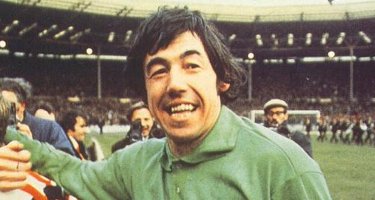
Perhaps the greatest English goalkeeper of all time, Banks will live, forever, in English football lore for his time as England’s number 1 goalkeeper during the 1966 and 1970 World Cups. In 1966, Banks was virtually impenetrable, keeping four straight clean sheets before being beaten on a penalty kick from Portuguese legend, Eusebio. Banks conceded two goals in the final against West Germany, the first as a result of miscommunication with defender Jack Charlton, and the other on a deflected free kick, but was instrumental in shutting the door on West Germany during extra time, turning away a shot from Siggy Held that would have equalized the match after England had gone ahead.
In 1970, Banks would add to his legend, turning away a shot from Pele that’s been called the greatest save in football history. During their group-stage match, Brazil and England were deadlocked at 0-0 when Jairzinho beat his defender down the right wing and sent a long cross towards the far post where Pele waited. All Pele needed to do was get his head on the ball and he would, seemingly, have the easiest goal of his career. Surely, Banks, who had been guarding the near post and, as a result, was way out of position following Jairzinho’s cross, was easily beaten and wouldn’t have gotten to the shot unless he had bionic arms. So confident was Pele that his header was going in that he turned away and shouted “Goal!” as soon as he made contact. Banks, however, leap across his line with superhuman effort and managed to get enough of a touch to send it out for a corner. Pele was dumbfounded and later described that save as the best he had ever seen. England eventually lost to Brazil, but managed to advance to the Quarterfinals, where they lost to West Germany. Banks proved his value to the team, as he fell violently ill before the match and had to miss out. His understudy was breached 3 times and England’s title defense was over.
On the club level, Banks played extremely well for Leicester and Stoke, although the silverware was much harder to come by. He won the 1964 League Cup with Leicester, but memorably lost in the F.A. Cup Final to Manchester United in 1963, the latter playing in its first trophy since the Munich Air Disaster. Banks’ career was cut short after he was injured in a car accident that left him blind in one eye. He recovered enough to play for the NASL, but was never the same.
Regardless of how things ended for him, he remains the greatest English goalkeeper of all time, and the only one to ever hold the World Cup.
Gordon Banks VIDEO:
.
.
.
Dino Zoff |
 |
|
| ITALY | ||
| 1961-1983 | ||
| Udinese (1961-1963) Mantova (1963-1967) Napoli (1967-1972) Juventus (1972-1983) |
||
.
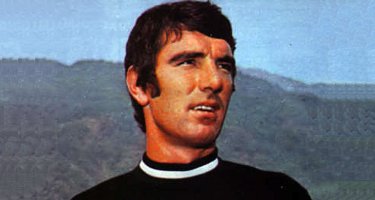
He was a winner with both club and country, and most pundits have ranked him among the top three goalkeepers of all time. He was one of the greatest keepers in Serie A history, winning six Scudetti, two Coppa Italia titles, and one UEFA Cup during his tenure at Juventus. He had to wait a bit before he could achieve success on the international level. He made one start for Italy during their run to the 1968 European Champions, picking up a win against Bulgaria in the Quarterfinals, and didn’t play at all during the 1970 World Cup. When he finally became the undisputed Number One, he immediately showed that it was a long-time coming. He didn’t concede an international goal for an astounding 1,142 minutes, a span that lasted from 1972 to 1974. He captained Italy to the 1982 World Cup and became the oldest man to ever hold the trophy.
He had outstanding instincts, lightning-quick reflexes, and was a great shot-stopper. He wasn’t all natural talent, however, as he also had an excellent sense of positioning. Unlike some of his counterparts, who played with fire and passion, Zoff was unflappable on the pitch, projecting a quiet, but strong confidence that was infectious. He rarely yelled at teammates, almost never humiliated them, and was revered for his sportsmanship. His leadership during the 1982 World Cup was widely praised as he held his team together amid stinging criticism from the press back home in Italy. After early setbacks, the Italian team came together and put together an impressive string of victories that included wins against the Maradona-led Argentinean squad, Brazil, Poland, and West Germany.
Dignified and cool under pressure, Zoff showed that you don’t have to have an outsized personality to be a successful goalkeeper.
Dino Zoff VIDEO:
.
.
.
Sepp Maier |
 |
|
| GERMANY | ||
| 1965-1980 | ||
| Bayern Munich . . . |
||
.
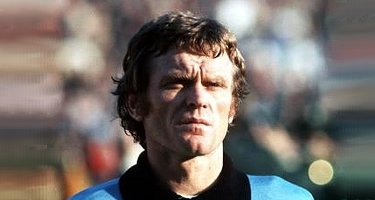
“The Cat from Anzing” was the backbone of a Bayern Munich franchise that produced some of the greatest teams of all time during the 1970’s. He was a member of the venerated, if unfortunately named “Axis” of Bayern Munich, combining with libero Franz Beckenbauer and striker Gerd Muller to win four Bundesliga titles, four German Cups, one Cup Winner’s Cup, and three consecutive European Cups. He was the undisputed German number-one goalkeeper when they established a two-year stretch of dominance in which they won the European Championships in 1972 and the World Cup in 1974. He was still the starter when West Germany nearly repeated as European Champions in 1976 (they lost in the Finals), and played well in the 1978 World Cup before retiring from the national team in 1979. He was as durable as he was reliable, playing in 422 consecutive matches for both club and country from 1966-1977, a German record.
Maier had always wanted to be an actor, and he brought his theatrical touch to the pitch. He was known for his outsized personality and became the template for a number of colorful goalkeepers that followed in his footsteps, ranging from Liverpool’s Bruce Grobbelaar, Mexico’s Jorge Campos, and the German duo of Oliver Kahn and Jens Lehmann (ironically, Maier’s contract as a goalkeeping coach with the national team was terminated after he criticized then-manager Jurgen Klinsmann’s decision to go with Lehmann over Kahn in advance of the 2006 World Cup). Maier once spent an entire match chasing after a duck that had flown onto the pitch instead of paying attention to the opposing team, which was as much as testament to Bayern Munich’s dominance as it was an indictment of Maier’s buffoonery. Later in life, he glued his shoes to the ceiling and hung upside-down. Unfortunately, he couldn’t keep his personal life in check and his career ended after he got into a drunk-driving related car accident.
Simply put, he was the greatest German keeper of all time, which is saying something. His hunting skills, on the other hand, could have used some work.
Sepp Maier VIDEO:
.
.
.
Peter Shilton |
 |
|
| ENGLAND | ||
| 1966-1997 | ||
| Leicester City (1966-1974) Stoke City (1974-1977) Nottingham Forest (1977-1982) Southampton (1982-1987) Derby County (1987-1992) Plymouth Argyle (1992-1995) Wimbledon (1995) Bolton Wanderers (1995) Coventry City (1995-1996) West Ham United (1996) Leyton Orient (1996-1997) |
||
.
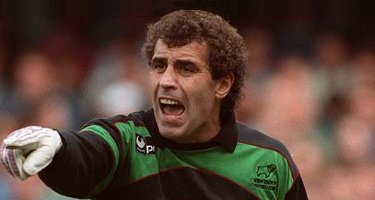
Shilton had the unenviable task of following in the footsteps of legendary goalkeeper Gordon Banks for both club and country. In doing so, he carved out a pretty good reputation for himself as one of the greatest keepers of all time. His 1,005 appearances is an all-time record for any professional in football, and remains England’s most capped player at 125 appearances. He won two European Cups, one League Title, and one League Cup (all with Nottingham Forest).
So highly regarded was he as a teenager that when Leicester City had to choose between him and World Cup hero Banks, the club chose to sell Banks to Stoke City. Shilton justified his club’s faith in him, leading Leicester to the 1969 F.A. Cup Final, and staying with the club after they were relegated. Shilton moved on eventually, spending time with many clubs in England. Shilton nearly signed with Manchester United in 1976, but his wage demands were too rich for United’s blood.
Shilton was known for his single-minded determination to be the best. When he was told that he wasn’t tall enough to make it as a goalkeeper, he spent several hours a day hanging from the stairs in his house in the hopes of getting taller. He was determined to own every single goalkeeping record in English history, and with the exception of Banks’ run of seven straight clean sheets (he reached six-a-row twice), he succeeded. He was England’s most capped player (a number that would have been much higher if England’s managers hadn’t rotated Shilton with Liverpool’s Ray Clemence). He kept 66 clean sheets. He played in 17 World Cup matches and kept 10 clean sheets (a record equaled by France’s Fabien Barthez). He went nearly 500 minutes without conceding a goal, a mark bettered only by Italy’s Walter Zenga.
Shilton found himself immortalized in football lore for a different reason in 1986 when he gave up the “Hand of God” goal to Diego Maradona. Luckily for Shilton, most of the media in England focused its anger on Maradona and not on Shilton. Obviously, Shilton doesn’t like to talk about this incident.
One of the hardest things to do in sports is to follow up a legend. Steve Young had to follow Joe Montana, Mickey Mantle had to follow Joe Dimaggio, and Shilton had to follow Banks. Through sheer force of will, Shilton became a legend himself.
Peter Shilton VIDEO:
.
.
.
Peter Schmeichel |
 |
|
| DENMARK | ||
| 1981-2003 | ||
| Gladsaxe-Hero (1981-1984) Hvidovre IF (1984-1987) Brøndby (1987-1991) Manchester United (1991-1999) Sporting Portugal (1999-2001) Aston Villa (2001-2002) Manchester City (2002-2003) |
||
.
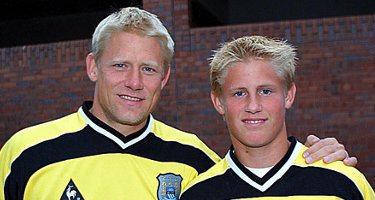
There has never been a better goalkeeper in the history of the Premiership than “The Great Dane.” Schmeichel had a pretty good career outside the Premiership, too, but it was his time at Manchester United where he became a legend. Schmeichel went to Old Trafford for the relatively paltry sum of £530,000, a price which Sir Alex Ferguson later teemed “The Bargain of the Century.” During his time in the Premiership, he kept clean sheets in 42% of his starts, the greatest ratio in league history. Schmeichel won 5 Premiership titles, 3 F.A. Cups, 1 League Cup, and, most notably, the 1998-1999 UEFA Champions League, where he served as skipper in place of suspended Roy Keane during the Finals and got to hold the trophy over his head on his last night as a United player. Schmeichel was voted UEFA Goalkeeper of the Year and World Goalkeeper of the Year in 1992 and 1993. He was recently voted “Greatest Goalkeeper of All-Time” in a Reuters poll, defeating the likes of Yashin and Banks.
Schmeichel had a successful international career as well. He remains the most-capped Danish player of all time with 129 appearances to his credit. He helped lead Denmark to the European Championship in 1992, and was the number one keeper for his country in the 1998 World Cup, where they fell to Brazil in the Quarterfinals.
Schmeichel wasn’t the nicest guy on the pitch. Indeed, the fiery keeper was accused of racism by Arsenal’s Ian Wright, and he was known for chewing out his own teammates for mistakes or errors. He was one of the few players to have survived a row with Sir Alex Ferguson, though. Evidently, the gaffer recognized his keeper’s worth and chose not to drive him away like he did with Keane, David Beckham, Ruud Van Nistelrooy, Jaap Stam, and others.
In any case, his shadow at Old Trafford remains so large that many quality goalkeepers have tried to replace him, and all have failed to measure up. Even Edwin Van der Sar, who has done well at United and has a chance to surpass the Great Dane in terms of trophies won, is always described as “the best goalkeeper since Schmeichel.” That’s a legend.
Peter Schmeichel VIDEO:
.
.
.
José Luis Chilavert |
 |
|
| PARAGUAY | ||
| 1982-2004 | ||
| Sportivo Luqueño (1982-1984) Club Guaranà (1984) San Lorenzo de Almagro (1984-1988) Real Zaragoza (1988-1991) Vélez Sársfield (1991-2000) RC Strasbourg (2000-2002) Peñarol (2002-2003) Vélez Sársfield (2003-2004) |
||
.
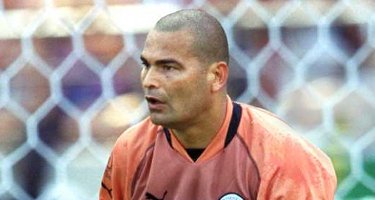
One of the few keepers who was as capable scoring goals as he was preventing them, this Paraguayan legend was one of the best free-kick takers in the world. He retired as the all-time leading scorer amongst goalkeepers, with a whopping 62 goals scored in all competitions, including 8 in international matches. He scored a hat-trick while playing for Velez, becoming the first goalkeeper to accomplish that feat.
His dead-ball ability gave his team a huge advantage, as they were able to have one unmarked man in the box whenever Chilavert came forward to take a free kick. He wasn’t just a one-trick pony, either. He was an excellent goal-keeper, winning the IFFHS World’s Best Goalkeeper award three times. He had a respectable 1.05 goals-against average in international matches, and won 57% of his starts. He was the backbone of the Velez team that won four Argentine titles (one Apertura title and three Clausura titles), the 1994 Copa Libertadores, and the 1994 Intercontinental Cup (defeating AC Milan by a score of 2-0). In 1998, he led Paraguay into the Round-of-16 in the World Cup, losing to eventual-winners France on a golden goal.
Unfortunately, his offensive skills weren’t limited to his free kicks. He famously spat on Roberto Carlos during a World Cup qualifier, leading to a three-match ban that caused him to miss the Paraguay’s first World Cup match in 2002. He engaged in brawls with numerous players, including Colombian international defender Jorge Bermudez, former Argentine captain Oscar Ruggeri and Colombian striker Faustino Asprilla. He also punched out an Argentine journalist who suggested that he had put on weight (I guess he was touchy about that — thank goodness he never walked the red carpet with Joan Rivers hounding him).
Still, he was the rarest breed of goalkeeper in that he was a force to be reckoned with on both sides of the ball. We could see another Yashin or Banks, but we probably won’t see another Chilavert.
José Luis Chilavert VIDEO:
.
.
.
Text & Career Summaries by Victor Li. Formatting and Image Research by Marco Pantanella.
Back to Football Legends homepage.
Add Sportslens to your Google News Feed!


